Wednesday, July 06, 2016
Travel Log - Day 2
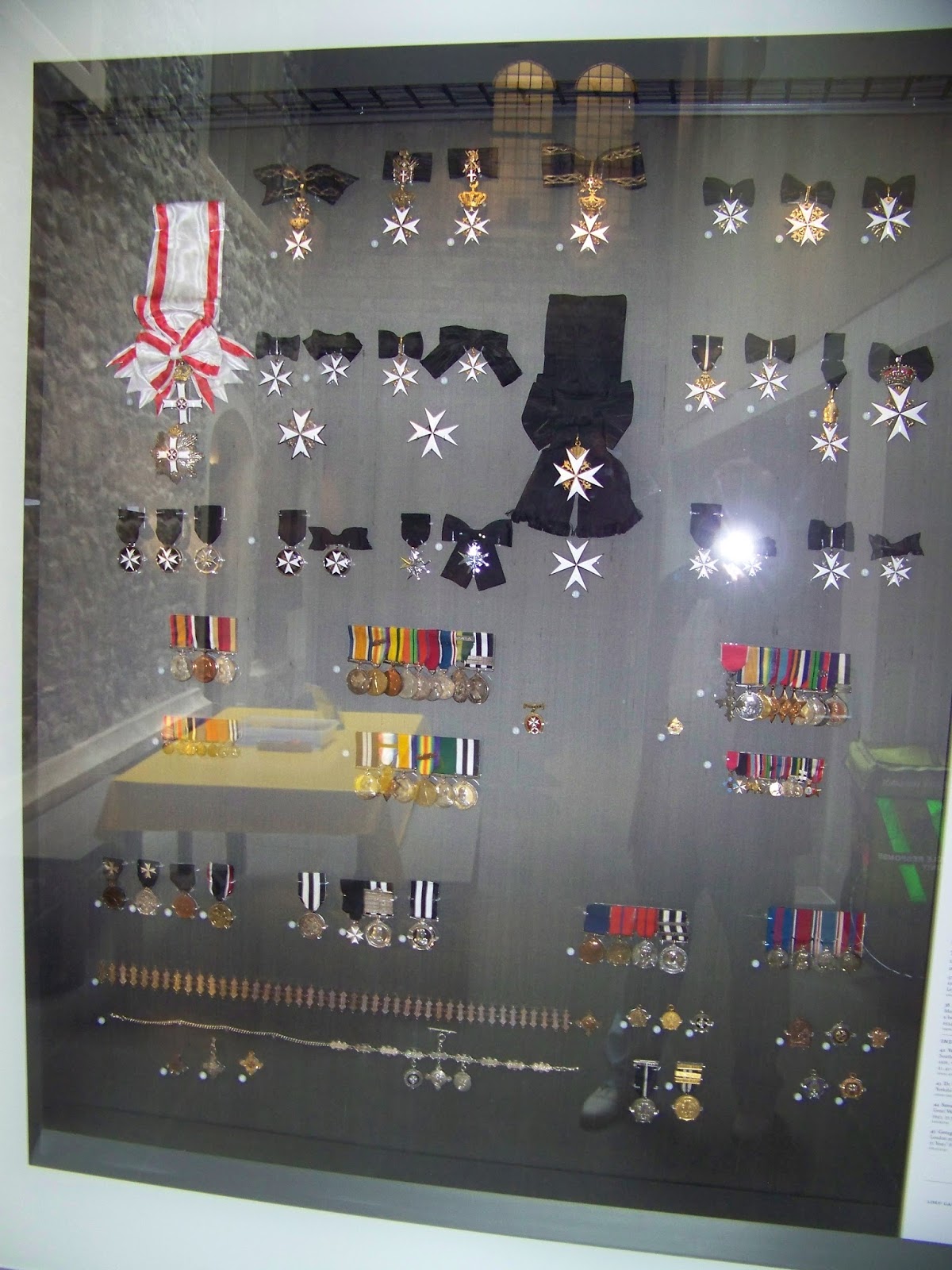
At the time of my last visit to London, the museum of the Order of St. John was closed for renovation. I went there today. It includes very interesting displays and the history of all of the Order - the origins in the Holy Land, Rhodes, Malta, and the various splits in the Order in modern times. Nearby is the International Headquarters of the Venerable Order. Here are a couple of photos of the museum.
Later I had very nice visit with Alan Hughes at Whitechapel Bell Foundry. We discussed clock bells for Zimbelsterns (pipe organ stop - accessory) and electrical striking of peal bells. We also chatted about history, Brexit, and other things. I did not know that there was, historically, a "White Chapel"! The park just a block away is where it was. It had burned down a couple of times, and finally they decided not to rebuild it. The park includes some of the original stone pieces.
Then I went to Corpus Christi Church for Latin Low Mass. This church is right next to the Covent Garden Market, and you can hear the market noise inside the church. There were about 50 people, 20's -70's there.
Mass was at this side altar since the main sanctuary was under renovation.
Monday, July 04, 2016
Travel Log - Day 1, Evening
I already mentioned seeing my former boss, Jan Rowland, at Temple Church for the opening event of the ISO Congress. This organ was recently refurbished by the organ builder, Harrison & Harrison of Durham. Temple Church was damaged during the Blitz in WWII, including the organ. The owner of a estate in Aberdeenshire had an organ in his ball-room that he wanted sell. The famous 20th century organist, Sir George Thalden-Ball took him up on the offer.
When I first visited the UK in 1980, I was most fortunate to have visited Temple Church one Sunday afternoon, only to notice Sir George still there after Evensong, chatting with a lady. When they were finished, I introduced myself. He was so gracious! He took my up to the console and started improvising - demonstrating various stops for me, and talking continuously! That was one the most memorable 30 minutes in my life!
He died only a few years later.
So, having not gotten to Mass yet, I headed for a pretty church nearby - Immaculate Conception, maintained now by Jesuits. It was a regular OF Mass, no music, for mostly 20-something Londoners. It was reverent, but it did contain some things in the Sanctuary that you might expect from Jesuits. The Church is beautiful!
Back to my room for bed, and trying to catch up on sleep. I'm running a day behind blogging - I'll try to catch up tomorrow.
Travel Log - Day 1, Morning
Well, a fair amount of my internet research hasn't paid off. It seems many of the churches that were listed as having a weekly Solemn High Mass are only having Low Mass instead. There are many, many beautiful Catholic churches here in London, as well as beautiful Anglican churches - like the ones I visit when ringing bells.
Since St. James Spanish Place was only going to be Low Mass, I decided to go ringing. I started out at St. Mary Abbots and got to ring some Grandsire Caters (9 bell method). The ringers were then going to two more churches to ring their bells for services. Many London churches do not have regular bell ringers, nor any significant numbers of parishioners who are ringers. The ringing is left to members of three or four groups of hobbyists.
The next church was St. Luke in Chelsea, and I rang a bit more Grandsire Caters. They are raising money to re-cast and re-hang the bells. They are a bit difficult to ring.
And then to St. Stephen, Rochester Row, where I rang some Stedman Triples (7 bell method). Their bells have been rehung, and are very nice to ring. The pendulum of the steeple clock swings in the middle of the ringing room.
Then I walked back to my room through Kensington Park, behind Kensington Palace.
Then just a short rest before late afternoon and evening places.
Travel Log - The Beginning of the Adventure
Traveling is an adventure. I believe that is what is should be. Sometimes it's a bit more of an adventure than one expects! I'll get to that.
Traveling internationally also includes "small world" events. I've had two already.
First, sitting in my assigned seat on Jet Blue headed to JFK, who should come and sit next to me in her assigned seat? Theodora Simons, from NYC, but her family has a house on Sullivan's Island. Theodora likes to sing and helps cantor at Stella Maris during the summer. We had just worked together the previous Sunday! She was heading to France for a month. Score one for Jet Blue computers!
Second, I went to Temple Church (yes, the one in "The DaVinci Code") for an organ concert demonstration for the ISO (International Society of Organbuilders) Congress opening event. I didn't see as many familiar faces as I had expected, having been in organ building for 30+ years. But I was pleasantly surprised to see my former boss and his wife - Jan and Hannah Rowland! We chatted about the "good ole days" and sat together for the concert. That was Sunday evening - and I have skipped a lot.
Back to the USA and Aer Lingus at JFK airport in NYC. There was a storm front coming through, including a tornado watch. This meant that the plane could not be fueled at the gate till the watch was ended. That storm front extended up the east coast in the direction that our flight (and many others) were headed. In the end, we took off three hours late! When we arrived in Dublin, I had missed my flight to London, which did not have a "no show" provision. So I lost on that one. I had this room in London booked and paid for, and there were no rooms (at least reasonably priced) in Dublin. Also, the next flight with a vacant seat was going to be Sunday afternoon - and another $400! Nope! I made my way down to the Port of Dublin and used "Sail and Rail" - taking the Irish Ferry across to Holyhead in Wales, and then trains to London.
So, instead of getting to London at about 9:00 am Saturday morning, I finally checked into Pembridge Hall at about 11:30 pm. I had missed out on the tickets waiting for me in will-call at the English National Opera for "Tristan und Isolde", and I was quite tired! But I had arrived safely and could get some sleep!
More about my first full day in London later.
Saturday, June 25, 2016
Brexit - the Aftermath
I posted a reply today on FaceBook to someone else's comment, and I will expand a bit on it here:
I love Europe. I am thankful that the US helped in two world wars so that the nations in the continent of Europe could be free.
Having been a pipe organ builder for much of my life, I would like to visit Germany and France to see all sorts of organs and churches, and also to attend EF Masses. I am also 1/2 German (and that 1/2 Protestant and 1/2 Catholic). But I feel no affinity with either country, nor do I desire to be German or French.
There are places in Spain and Ireland that I would like to see - both architeture and countryside. And I am almost 1/2 Irish (and again, that 1/2 Protestant and 1/2 Catholic). But I feel no affinity with either Ireland or Spain, and even though my AOH brothers might be sad to hear it, I have no desire to be either Irish or Spanish.
There ARE a number of reasons why I do feel an affinity with Great Britain - bell ringing is only one of them. I would like to be British, but I have no real desire to be European. It only means as much as being an American citizen makes me a North American. Sitting here across the Pond and seeing an entire continent of sovereign nations become as powerless as any State in the USA has been painful for me to watch. I am so proud of the British, including the Monarchy, that the Pound Sterling was kept even when almost all the other countries climbed onto the Euro bandwagon, and that there is still a more than significant military. I firmly believe that, not just England, but every country that would leave the EU, will be better off as sovereign nations once again. As human beings we all know that it takes time to fix repercussions from bad decisions we have made in the past.
Tuesday, June 21, 2016
Memorial Aclamations for the Anglican Ordinariate
As previously promised, here are the three Memorial Acclamations with the Book of Divine Worship Missal translation.
Here is Acclamation A:
Here is Acclamation B:
Here is Acclamation C:
As promised last week, here is the accompaniment:
If you have trouble using these graphics, let me know. I can supply TIF files for inserting into congregation worship aids and a PDF of the accompaniment page.
Sunday, June 05, 2016
Revisiting an old 2007 post - Memorial Acclamation
Some years ago I posted the Memorial Acclamation we used at Our Lady or Walsingham in Houston for many years. It was the older ICEL text "Christ has died. Christ is risen. Christ will come again." Here it is to remind you:
Of course, that text is no longer allowed - we have much better texts since 2011. So I have composed new acclamations based on this melody.
Here is Acclamation A:
Here is Acclamation B:
Here is Acclamation C:
We will begin singing Acclamation A here at Stella Maris Church next Sunday, 12 June 2016.
These are JPG files. If anyone wishes to use them, go right ahead. I have them as TIF files as well.
If you would like the TIF files and/or a PDF of the accompaniment, I can send them as attachments to an email.
Thursday, May 26, 2016
Sacra Liturgia UK 2016
After some years, I have decided to reactivate (start using again) my blog here.
I will be attending the Sacra Liturgia UK Conference in London this July 5th-8th, and I will use this blog as a travel log.
http://www.sacraliturgiauk.org/

I will post a few photos on FaceBook and include links to this blog there.
I will be staying at University Housing B&B in Notting Hill for 2 weeks, then traveling up to Edinburgh for a couple of days; then Manchester; and finally Dublin for my last weekend. I depart Charleston at Noon, July 1st, and return July 25th.
Besides the Conference, my purpose for making this trip is attending EF Mass (Traditional Latin Mass / Tridentine Mass) in as many churches as possible, making contact with priests and musicians at each. I will, of course, try to get some bell ringing in while there.
I will be attending the Sacra Liturgia UK Conference in London this July 5th-8th, and I will use this blog as a travel log.
http://www.sacraliturgiauk.org/
I will post a few photos on FaceBook and include links to this blog there.
I will be staying at University Housing B&B in Notting Hill for 2 weeks, then traveling up to Edinburgh for a couple of days; then Manchester; and finally Dublin for my last weekend. I depart Charleston at Noon, July 1st, and return July 25th.
Besides the Conference, my purpose for making this trip is attending EF Mass (Traditional Latin Mass / Tridentine Mass) in as many churches as possible, making contact with priests and musicians at each. I will, of course, try to get some bell ringing in while there.
Wednesday, April 02, 2008
Pope Watch - Washington Post
There is much dissent among Catholic musicians over the musical choices for the Masses during Pope Benedict's upcoming American visit. Here is the Washigton Post's blog:
http://blog.washingtonpost.com/pope-watch/2008/03/musical_disharmony_part_ii_1.html
Here is the comment that I just left:
What large group speaks for whom?
I admit that I joined the CMAA late in my musical/liturgical life. It was my mistake. For your information, there is a document on the CMAA website, authored by Msgr. Richard Schuler, which chronicles the reform of the Mass since St. Pope Pius X, with emphasis on implementation in the USA throughout. It is very interesting reading when you get to the Vat. II implementation era! It details the origins of NPM, giving names, places, and dates.
Having pointed you to that document, I must now admit that I attended, with much joy and commitment, the NPM Convention in Chicago back in 1979. Although it was a great "musical" experience, singing under both Alexander Peloquin and Joseph Gelineau, I now consider that a mistake equal to that of waiting so long to join CMAA. I would never, ever consider attending a NPM convention again. I do not support any of that groups views, not do they support a singal one of mine.
My boss has tickets to the President's greeting the Pope on the White House lawn. He is taking his teenage daughter with him. I'm sure it will be a wonderful experience. I would not waste the time or train ticket to sit in a crowded not-church for a Mass with this sort of non-liturgical music. I will probably listen to Sirius radio for most of the events just to hear what is going on. So far, I am embarrassed to be considered a Catholic musician along side the people putting on these ultra-contemporary Liturgies.
http://blog.washingtonpost.com/pope-watch/2008/03/musical_disharmony_part_ii_1.html
Here is the comment that I just left:
What large group speaks for whom?
I admit that I joined the CMAA late in my musical/liturgical life. It was my mistake. For your information, there is a document on the CMAA website, authored by Msgr. Richard Schuler, which chronicles the reform of the Mass since St. Pope Pius X, with emphasis on implementation in the USA throughout. It is very interesting reading when you get to the Vat. II implementation era! It details the origins of NPM, giving names, places, and dates.
Having pointed you to that document, I must now admit that I attended, with much joy and commitment, the NPM Convention in Chicago back in 1979. Although it was a great "musical" experience, singing under both Alexander Peloquin and Joseph Gelineau, I now consider that a mistake equal to that of waiting so long to join CMAA. I would never, ever consider attending a NPM convention again. I do not support any of that groups views, not do they support a singal one of mine.
My boss has tickets to the President's greeting the Pope on the White House lawn. He is taking his teenage daughter with him. I'm sure it will be a wonderful experience. I would not waste the time or train ticket to sit in a crowded not-church for a Mass with this sort of non-liturgical music. I will probably listen to Sirius radio for most of the events just to hear what is going on. So far, I am embarrassed to be considered a Catholic musician along side the people putting on these ultra-contemporary Liturgies.
Monday, January 21, 2008
Accompanied Gregorian Chant
Yes, I am biased for accompanied chant.
It is what I grew up with – in the Rev. Carlo Rosinni vein. His is by far NOT the worst an organist can stumble onto. I have heard accompanied chant in many places. Much of it really is quite distracting, and even harsh sounding.
I have yet to meet Jeff Ostrowski, but we have been in touch for some years now. He provided me with a copy of “Nova Organi Harmonia”. (http://jeff.ostrowski.cc/productions/nova/) It is a truly remarkable book, and is to a great extent mirrored in his “Chabanel Psalms” accompaniment. (http://chabanelpsalms.org/) While I occasionally use some of the Rosinni accompaniments, as well as a few of the LaPierre, the NOH has become my staple for accompaniment. My continuing to comment that it is strictly “modal” in its harmonic approach simply cannot present to you the beauty that it creates. In my ear it sounds like angel choirs singing along with me. Other historic examples of organ accompaniments have shown up on the internet recently, and I have down-loaded them to try them out. Frankly, the Rossini versions sound better in many cases. But they are still no match for the NOH.
The history of Gregorian chant, and our use of it, seems to me to be akin to the Jesuits – they’re in, they’re out, they make changes, they get away with it, and it all becomes history. It had fallen into almost complete disuse by the time St. Pope Pius X began moving to reform the Liturgy. It was at that point that most of the accompaniments we are speaking of began. I believe that these recent generations of organist/composers did their honest best to enhance the art form, especially for the use in parishes without experienced scholas. And further, that the NOH was the ultimate, the pinnacle of these generations’ work. It is at least in this aspect that it deserves the title of “tradition” (yes, with a small ‘t’).
What was the pipe organ used for when it became the instrument of the western Church? It was centuries before Buxtehude, Bach, Mozart, etc. The Office was only celebrated in Cathedrals and Monasteries – and that was the only place for hymnody. The Mass had only Propers and Ordinaries, most of which had already been established melodically for centuries. It is only logical to assume that it was used to aid the singing of whatever was being sung – almost assuredly Gregorian chant. What did they do, and how did they do it. And why don’t we know anything about it.
Here is my logical, non-academic suggestion: Any organist given the task of accompanying chant already knew the chant in depth. In the earliest of times, the “grand staff” was still experimental, if it existed at all. I’m convinced that the organist improvised whatever was needed, given the chant, the voices, and the building. Then why did he not write it down?
I think the question is why should he have? He knew what he had done. It would take hours to write it out. And what would he do with it? He could certainly do it again, even making changes from the first time. He had no need of a printed copy. And there were no printing presses. And all of his fellow organists were doing the same thing, in the their own ways. And they weren’t writing anything down either! Nor were they looking around for hand-written copies from other organists.
Now, I’m not saying that Gregorian chant was accompanied from the beginning. It wasn’t even “Gregorian” from the beginning! All I’m suggesting is that it IS a tradition, going back earlier that the 1950s, and even earlier than the 1850s. And that it is NOT an abuse, either of the music or of the Liturgy. As my mother told me when I first started learning to play an instrument: Music is not just the black ink on the white paper. It’s what we make of it when performing it.
It is our job to do the best we can to make beautiful music to the glory of God, and to the listeners to take away from their experience of worship whatever they are capable of or interesting in taking from it.
One last argument!
Much of our ‘modern’ Liturgy, we have been told, is from the earliest forms of the Liturgy. Modern ‘liturgists’ have been beating us over the head with that argument for 40 years. Everything done long before the Council of Trent was to be adopted (and adapted), and everything since that time was to be shunned. The whole of Liturgy and music has been evolving all along, as has our culture and civilization. Most of us here in this area of the blogosphere think/feel that the experimental Liturgies post Vat. II are, at least partly, failures. Are we to let some people now rule that true Gregorian chant must reflect only the earliest possible performance practices, and shun any and all development over the last 1,000 years? Is that what Jubilæum 2000 was all about?
Christus heri! Christus hodie! Christus semper!
It is what I grew up with – in the Rev. Carlo Rosinni vein. His is by far NOT the worst an organist can stumble onto. I have heard accompanied chant in many places. Much of it really is quite distracting, and even harsh sounding.
I have yet to meet Jeff Ostrowski, but we have been in touch for some years now. He provided me with a copy of “Nova Organi Harmonia”. (http://jeff.ostrowski.cc/productions/nova/) It is a truly remarkable book, and is to a great extent mirrored in his “Chabanel Psalms” accompaniment. (http://chabanelpsalms.org/) While I occasionally use some of the Rosinni accompaniments, as well as a few of the LaPierre, the NOH has become my staple for accompaniment. My continuing to comment that it is strictly “modal” in its harmonic approach simply cannot present to you the beauty that it creates. In my ear it sounds like angel choirs singing along with me. Other historic examples of organ accompaniments have shown up on the internet recently, and I have down-loaded them to try them out. Frankly, the Rossini versions sound better in many cases. But they are still no match for the NOH.
The history of Gregorian chant, and our use of it, seems to me to be akin to the Jesuits – they’re in, they’re out, they make changes, they get away with it, and it all becomes history. It had fallen into almost complete disuse by the time St. Pope Pius X began moving to reform the Liturgy. It was at that point that most of the accompaniments we are speaking of began. I believe that these recent generations of organist/composers did their honest best to enhance the art form, especially for the use in parishes without experienced scholas. And further, that the NOH was the ultimate, the pinnacle of these generations’ work. It is at least in this aspect that it deserves the title of “tradition” (yes, with a small ‘t’).
What was the pipe organ used for when it became the instrument of the western Church? It was centuries before Buxtehude, Bach, Mozart, etc. The Office was only celebrated in Cathedrals and Monasteries – and that was the only place for hymnody. The Mass had only Propers and Ordinaries, most of which had already been established melodically for centuries. It is only logical to assume that it was used to aid the singing of whatever was being sung – almost assuredly Gregorian chant. What did they do, and how did they do it. And why don’t we know anything about it.
Here is my logical, non-academic suggestion: Any organist given the task of accompanying chant already knew the chant in depth. In the earliest of times, the “grand staff” was still experimental, if it existed at all. I’m convinced that the organist improvised whatever was needed, given the chant, the voices, and the building. Then why did he not write it down?
I think the question is why should he have? He knew what he had done. It would take hours to write it out. And what would he do with it? He could certainly do it again, even making changes from the first time. He had no need of a printed copy. And there were no printing presses. And all of his fellow organists were doing the same thing, in the their own ways. And they weren’t writing anything down either! Nor were they looking around for hand-written copies from other organists.
Now, I’m not saying that Gregorian chant was accompanied from the beginning. It wasn’t even “Gregorian” from the beginning! All I’m suggesting is that it IS a tradition, going back earlier that the 1950s, and even earlier than the 1850s. And that it is NOT an abuse, either of the music or of the Liturgy. As my mother told me when I first started learning to play an instrument: Music is not just the black ink on the white paper. It’s what we make of it when performing it.
It is our job to do the best we can to make beautiful music to the glory of God, and to the listeners to take away from their experience of worship whatever they are capable of or interesting in taking from it.
One last argument!
Much of our ‘modern’ Liturgy, we have been told, is from the earliest forms of the Liturgy. Modern ‘liturgists’ have been beating us over the head with that argument for 40 years. Everything done long before the Council of Trent was to be adopted (and adapted), and everything since that time was to be shunned. The whole of Liturgy and music has been evolving all along, as has our culture and civilization. Most of us here in this area of the blogosphere think/feel that the experimental Liturgies post Vat. II are, at least partly, failures. Are we to let some people now rule that true Gregorian chant must reflect only the earliest possible performance practices, and shun any and all development over the last 1,000 years? Is that what Jubilæum 2000 was all about?
Christus heri! Christus hodie! Christus semper!
Subscribe to:
Posts (Atom)